The Event Planning Checklist for Corporate & Private Events
An event planning checklist is an essential tool for keeping every detail on track. It helps you define what success looks like, make important decisions early, and ensure nothing is overlooked. By planning ahead, you have more time to make changes and avoid unnecessary stress or costs closer to the event.
This checklist is built for corporate and private events: conferences, town halls, dinner and dance nights, product launches, gala dinners, birthdays and milestone celebrations. It works at 150 guests and at 1,500, and it is banded by lead time so you can start from whatever runway you have left.
What follows covers the planning horizons in order, a worked run sheet example, a roles table to keep everyone accountable, a contingency section in the event of unforeseen circumstances, and the Singapore licences to check before you commit. Work the bands in order, and give every item an owner and a date.
Table of contents
- 6 to 12 Months Out: Objectives, Budget, Date and Venue
- 3 to 6 Months Out: Catering, AV, Programme and Promotion
- 1 to 3 Months Out: Headcount, Floor Plan and Compliance
- The Final Two Weeks, Event Day and the Run Sheet
- Where D’Marquee Fits into the Checklist
- After the Event: Teardown, Settlement and Measurement
- Frequently Asked Questions
- Running Your Next Event with Confidence
6 to 12 Months Out: Objectives, Budget, Date and Venue
This band answers why the event exists and what it will physically be. An error at this stage can affect every decision that follows.
Objectives and success measures
- State the purpose: recognise staff, launch a product, brief the organisation, celebrate a milestone.
- Attach two or three measurable outcomes, such as attendance against invitations, satisfaction score, qualified leads or funds raised, and agree who signs them off now.
- Define the audience, since employees, clients, dealers and family guests each pull the tone, format and guest count in a different direction.
Budget framework, qualitatively
Build the budget as line items rather than one number. For most corporate and private events, catering and beverage costs the most, followed by venue and access hours, then AV and production, then décor and branding, with staffing, transport, entertainment and permits filling the remainder.
Seven levers move the total: date and season, guest count, layout, catering and service style, AV scope, décor and branding, and access hours. Layout is the most underestimated, since a seated banquet with a stage and dance floor needs far more floor area per guest than a theatre-style briefing.
Hold a contingency as a percentage of your own budget and protect it. Then ask every venue and vendor for a line-item quote covering room, hours, AV, catering, décor and staffing, so the quotes you compare read like for like.
Date, guest count and venue shortlist
- Fix the date, or a first and second choice, and check it against public holidays, school holidays, industry calendars and your own reporting cycles.
- Set a working guest count and a maximum, since capacity by layout is what venues quote against.
- Shortlist three or four venues that can carry your format, then visit them. A site visit tells you about sightlines, ceiling height, arrival flow and noise in a way a floor plan cannot. Ask for capacity across all four layouts rather than one headline figure.
- Sign only once inclusions, access hours, cancellation terms, vendor policy and postponement rights are in writing.
3 to 6 Months Out: Catering, AV, Programme and Promotion
With the room secured, this band turns the event from a booking into a programme.
Catering and menu
- Choose the service style: plated, buffet, live stations, canapé reception or a mix across the evening.
- Confirm dietary coverage early, including halal-friendly, vegetarian, allergy and children’s options, and how each is identified at the table.
- Ask how tastings work, when the menu must be locked, and what the beverage and corkage terms are.
AV scope
- Match AV to the programme, not to ambition. A town hall needs clear speech reinforcement and reliable slide playback; an awards night needs staging, lighting states and video.
- Book a technical walkthrough, share the running order, and confirm what is house-supplied, what is hired in and who is on site during the event.
- Raise rigging and power early with the venue: what can be hung, from where, and the supply available at the stage position.
Décor, branding, programme and invitations
- Lock the theme and colour direction, then brief backdrops, entrance features, table settings and branded elements.
- Draft the programme with realistic segment lengths. Speeches always run long; build slack in.
- Confirm speakers, hosts, emcees and entertainment in writing, with arrival times and technical requirements.
- Open registration, decide between a platform, QR check-in or a printed name list, and set the reminder schedule so the final headcount arrives when you need it.
1 to 3 Months Out: Headcount, Floor Plan and Compliance
This band converts intentions into confirmed numbers and signed approvals.
Headcount, seating and floor plan
- Close registration or RSVPs on a stated date and build in a buffer for late confirmations and no-shows.
- Draw the floor plan against the confirmed headcount: stage position, screen sightlines, table numbering, service points, registration desk and circulation routes.
- Walk the plan from the guest’s point of view, from car park to seat, and look for pinch points.
- Confirm signage: directional signs from the drop-off point, registration, seating charts and washrooms.
Transport, parking and access communications
Guest arrival is where most complaints originate, and it is fixable with information. Confirm the details with your venue, then publish them in the invitation and the reminder.
Ask the venue directly: how many parking lots are available and are they shared, is there a charge or redemption scheme, where is the drop-off point, is there a shuttle service from the nearest MRT station, and where should coaches wait? Ask the same for vendors: when can they load in, where is the loading access, and what floor loading applies to heavy equipment.
Licences, approvals and insurance in Singapore
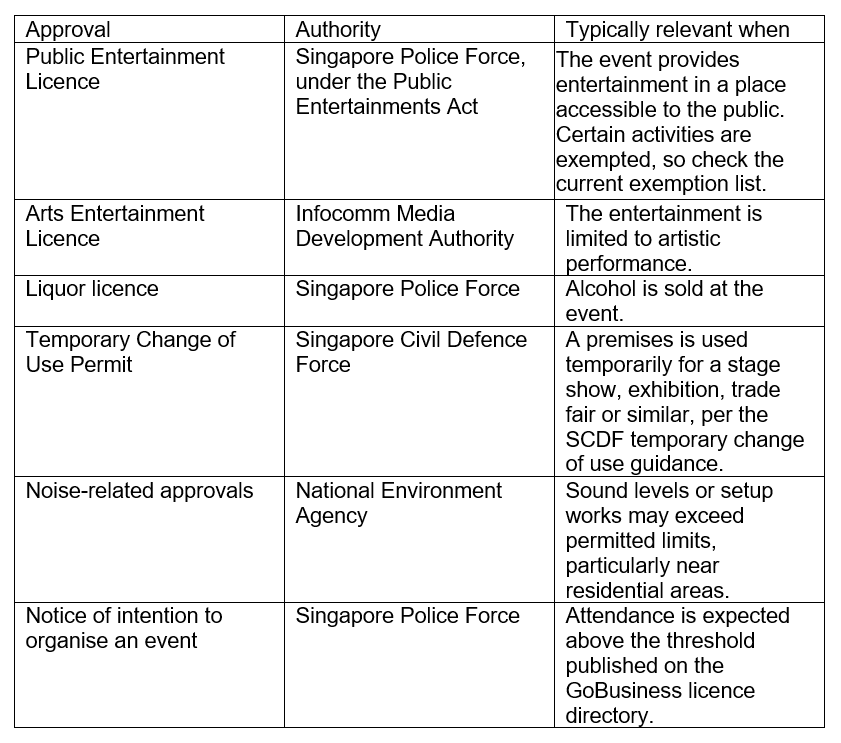
Compliance is the stage most checklists skip, and one of the few that can stop an event outright. Requirements depend on format, venue and audience, so treat the table below as questions to raise with your venue and the relevant authority rather than a determination.
Established indoor venues usually hold the standing approvals for their premises and will tell you what your programme adds on top. Ask in writing and ask early, because some applications carry a lead time. Confirm your insurance position too: public liability cover, whether the venue requires naming on the policy, and whether vendors carry their own. Then reconfirm every vendor in writing with arrival time, contact number and scope.
The Final Two Weeks, Event Day and the Run Sheet
The last fortnight is about locking, not deciding. Any unconfirmed elements here become a risk on the day.
The run sheet, with a worked example
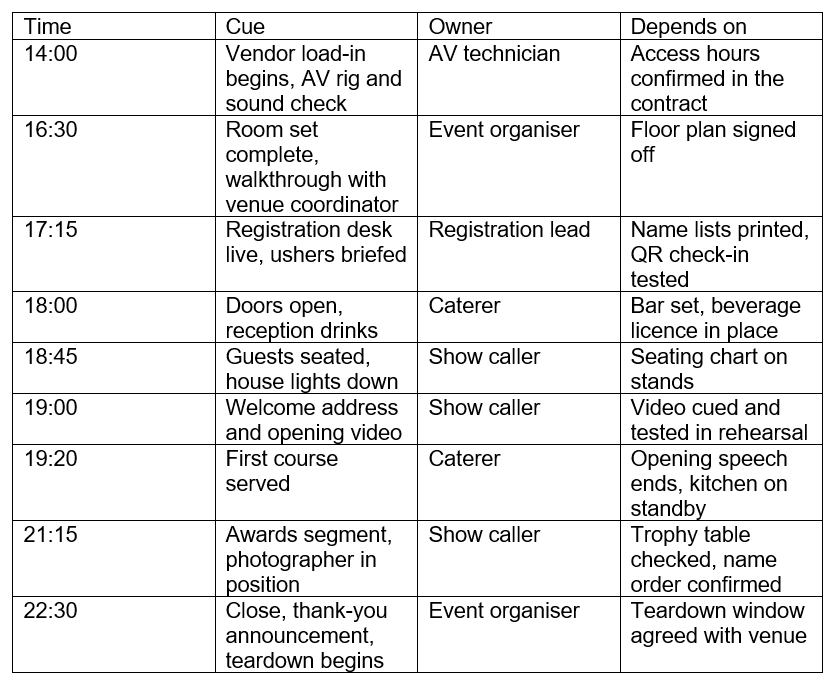
A run sheet, also called a cue sheet or run of show, is a minute-by-minute operational timeline covering roles, responsibilities and timing across setup, the live programme and teardown. It is the document everyone works from, and the item most checklists leave out.
Build yours in the same format: time, cue, owner, dependency. Then rehearse on site if the programme has any live element, and issue briefing packs with the run sheet, floor plan, contact list and escalation path.
Day-of Responsibilities
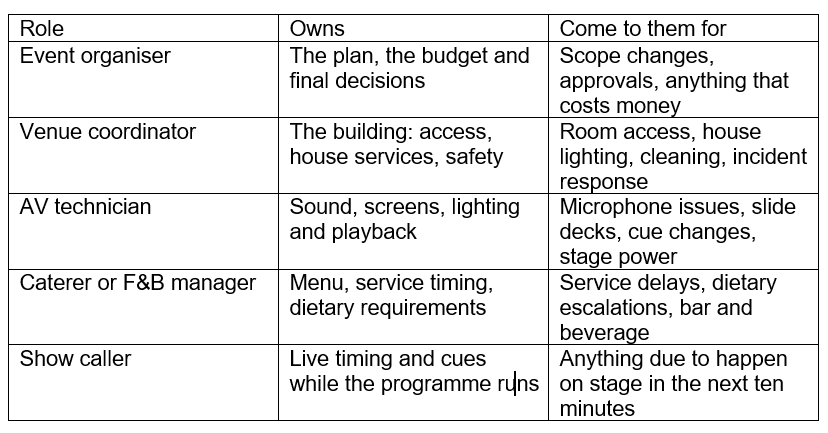
Ambiguity about ownership can cause unnecessary hiccups. Publish this table with your run sheet.
Risk and contingency planning
Write a one-page contingency plan and put it in every briefing pack. Cover five scenarios at minimum:
- Wet weather. Even indoors, rain changes arrivals. Confirm the covered drop-off route, add umbrella cover at the entrance and expect registration to bunch.
- Speaker or performer no-show. Name a standby, prepare a filler segment, and agree with the emcee how the programme resequences without announcing the problem.
- Power or AV failure. Confirm backup lighting, a spare microphone and a second copy of every video and slide deck on a separate device. Agree who calls the pause.
- Medical incident. Know where the first aid point is, who calls emergency services, who clears the access route and who holds the room.
- Crowd flow. Registration, buffet lines, washrooms and exits congest fastest. Stagger arrivals, add a second registration lane, and brief ushers on where to redirect queues.
Name the decision-maker and the trigger point for each scenario. A contingency plan without a named decision-maker is a document nobody opens.
Looking to host impactful and unforgettable event experiences? Talk to us today and we will work through the checklist with you.
Where D’Marquee Fits into the Checklist
D’Marquee at Downtown East, 1 Pasir Ris Close, Singapore 519599, is a single 2,400 sqm fully pillarless hall with 8 m ceilings, which is what makes several checklist stages simpler.

At the floor plan stage, a column-free floor means the seating plan follows the stage rather than the structure, so sightlines stay clean to the back of the room and formats can change between sessions.
At the AV scoping stage, technical delivery runs through technical partner Expo AV, covering high-definition sound, cinematic LED lighting and large-format screens. The 8 m ceiling gives room for rigged elements that a standard 3 to 4 m ballroom ceiling cannot take.
At the catering and décor stage, both are arranged through trusted vendor partners, including halal-friendly catering for multicultural celebrations.
For multi-day programmes, the wider Downtown East ecosystem carries what a single hall elsewhere cannot: D’Resort accommodation, on-site dining and attractions such as Wild Wild Wet on the same site. There is ample on-site parking, a free shuttle bus runs between Pasir Ris MRT and Downtown East, and Changi Airport proximity shortens transfers for overseas delegates.
Operating since 2002 and relaunched as D’Marquee 2.0, the BCA Green Mark GoldPLUS Award recipient hall is perfect for events from a few hundred guests up to convention scale. For intimate gatherings under 50 guests, Begonia Ballroom, the Vanda Room at D’Resort and the other Downtown East function spaces are better suited; for multi-hall exhibitions beyond roughly 2,500 guests, Singapore EXPO, Suntec Singapore Convention & Exhibition Centre, Sands Expo & Convention Centre and Resorts World Convention Centre are the right call at that scale. See how the floor is configured by occasion on the Occasions hub, or scope venue, AV, catering and décor together through our customised event solutions.
After the Event: Teardown, Settlement and Measurement
An event is only complete once the paperwork is settled and the lessons are captured. Run this band within two weeks while memories are fresh.
- Teardown. Confirm the teardown window, assign someone to collect equipment, signage and lost property, and walk through with the venue coordinator before handing the room back.
- Settlement. Reconcile every invoice against the line-item quote, query variations immediately, and note which lines exceeded the estimate and why. This is next year’s baseline.
- Feedback. Send a short survey within 48 hours. Gather vendor and internal team feedback separately.
- Measurement. Report against the objectives set in the first band, not a fresh set: attendance versus invitations, satisfaction score, leads generated, and media pickup.
- Debrief. Hold a short team debrief on what worked and what nearly went wrong, then file it with the run sheet so the next event starts from a finished document.
Frequently Asked Questions
How far in advance should I start planning an event?
Allow roughly 12 months for large conferences, 5 to 6 months for mid-size corporate events, and 8 to 12 weeks minimum for smaller functions. External speakers, ticketing or heavy production push you to the longer end. Secure the venue first, because dates go before anything else.
What should be included in an event planning checklist?
At minimum: objectives and success measures, a budget framework with a contingency, date, guest count, venue and contract, catering, AV scope, programme, registration, floor plan and seating, signage, transport communications, licences and insurance, vendor confirmations, a run sheet, contingency plans, and post-event settlement and measurement.
What are the five stages of event planning?
Most frameworks describe five: setting objectives and budget, planning and design, promotion and registration, execution on the day, and post-event evaluation. The timeline bands here map onto those stages, with the last two weeks treated separately because they are about locking decisions rather than making them.
What licences do I need to hold an event in Singapore?
It depends on the format and the venue. Common ones include a Public Entertainment Licence from the Singapore Police Force, an Arts Entertainment Licence from IMDA for artistic performances, a liquor licence where alcohol is sold, an SCDF Temporary Change of Use Permit for uses such as exhibitions and stage shows, and noise-related approvals from NEA. Established indoor venues usually hold standing approvals for the premises, so ask in writing what your programme adds.
How are event-day responsibilities assigned?
The event organiser owns the plan, budget and final decisions; the venue coordinator owns the building, access and safety; the AV technician owns sound, screens, lighting and playback; the caterer owns menu and service timing; and the show caller drives live cues. Publish the list with your run sheet.
Running Your Next Event with Confidence
An event planning checklist works because it brings decisions forward and makes responsibilities clear before the event begins. Work the bands in order, close each one before moving on to the next, and keep three documents current throughout: the budget with its line items, the floor plan, and the run sheet.
For corporate and private events from a few hundred guests up to convention scale, D’Marquee’s 2,400 sqm pillarless hall with 8 m ceilings at Downtown East covers classroom, banquet, theatre and arena formats on one floor, with Expo AV on technical delivery and trusted vendor partners on catering and décor.
Looking to host impactful and unforgettable event experiences? Talk to us today and we will map your programme, layout and vendor scope to your date.